Commercial-Grade Slope Mower: 10 Specs to Compare
A commercial slope mower should offer more than remote operation. Compare the construction, traction, safety, serviceability, and long-term support BEHIND the machine.
Quick Answer: What Makes a Slope Mower Commercial-Grade?
A commercial-grade slope mower is engineered for repeated professional use on steep, rough, and unpredictable terrain. It should combine heavy-duty construction, a stable track system, balanced weight distribution, a dependable commercial engine, sufficient cutting capacity, integrated safety controls, accessible recovery equipment, readily available replacement parts, customization options, and long-term manufacturer support.
A remote control alone does not make a mower commercial-grade.
Some inexpensive RC mowers are built for light residential maintenance. Others are converted from consumer equipment without being engineered as a complete slope mowing system. A true commercial remote-controlled mower should be designed around the demands of contractors, municipalities, industrial facilities, government agencies, and large property owners.
The best commercial slope mower is not necessarily the machine with the lowest purchase price or the longest feature list. It is the machine built to perform safely, productively, and reliably throughout years of demanding work.
“Commercial-Grade” Should Describe the Entire Machine
The term “commercial-grade” is used frequently in equipment marketing, but buyers should look beyond the label.
A manufacturer may highlight one impressive feature, such as a powerful engine, remote control, wide deck, or steep maximum slope rating, without addressing how the complete machine performs under real working conditions.
Commercial capability depends on how every major system works together:
- The frame must withstand repeated stress.
- The deck must handle demanding vegetation.
- The tracks must maintain useful ground contact.
- The machine’s weight must be distributed appropriately.
- The engine must support the intended workload.
- The controls must respond predictably.
- Safety systems must allow the operator to stop the machine.
- Parts and service must remain accessible after the sale.
When comparing RC slope mowers, evaluate the complete machine instead of making a decision based on one specification, promotional video, or advertised slope angle.
1. Frame and Deck Construction
The frame is the foundation of a commercial slope mower. It supports the engine, cutting system, tracks, remote-control components, safety equipment, and recovery hardware while absorbing the forces created by steep and uneven terrain.
A machine used on hillsides may encounter ruts, rocks, stumps, drainage channels, thick vegetation, sudden grade changes, and repeated vibration. Lightweight construction that performs acceptably on a maintained yard may not withstand those conditions over years of commercial use.
Buyers should ask:
- Was the machine purpose-built for slope mowing?
- What materials are used in the frame and deck?
- Are critical components reinforced?
- Is the deck designed for repeated commercial mowing?
- Can damaged or worn sections be repaired?
- Does the manufacturer have fabrication experience?
- Can the machine be rebuilt or modified later?
Slope Master Innovations fabricates its remote-controlled mowers in Kentucky using an American-made, heavy-equipment approach. The company’s background in metal fabrication allows machines to be built, repaired, modified, and rebuilt according to the demands of the owner’s operation.
That is an important distinction between purpose-built equipment and a lightweight mower that has simply been adapted to accept remote controls.
2. Track System and Traction
Tracks are one of the most recognizable features of a commercial slope mower, but not all track systems provide the same capability.
The track system determines how much contact the machine maintains with the ground, how it distributes weight, and how effectively it moves across grass, soil, brush, and uneven surfaces.
A commercial track system should be evaluated for:
- Track width and ground contact
- Traction on steep grades
- Durability under repeated use
- Performance on loose or uneven soil
- Turning behavior
- Resistance to slipping or derailment
- Ease of inspection and maintenance
- Availability of replacement components
Wider ground contact can help distribute the mower’s weight and improve stability, but track design must work together with the machine’s frame, center of gravity, weight, and controls.
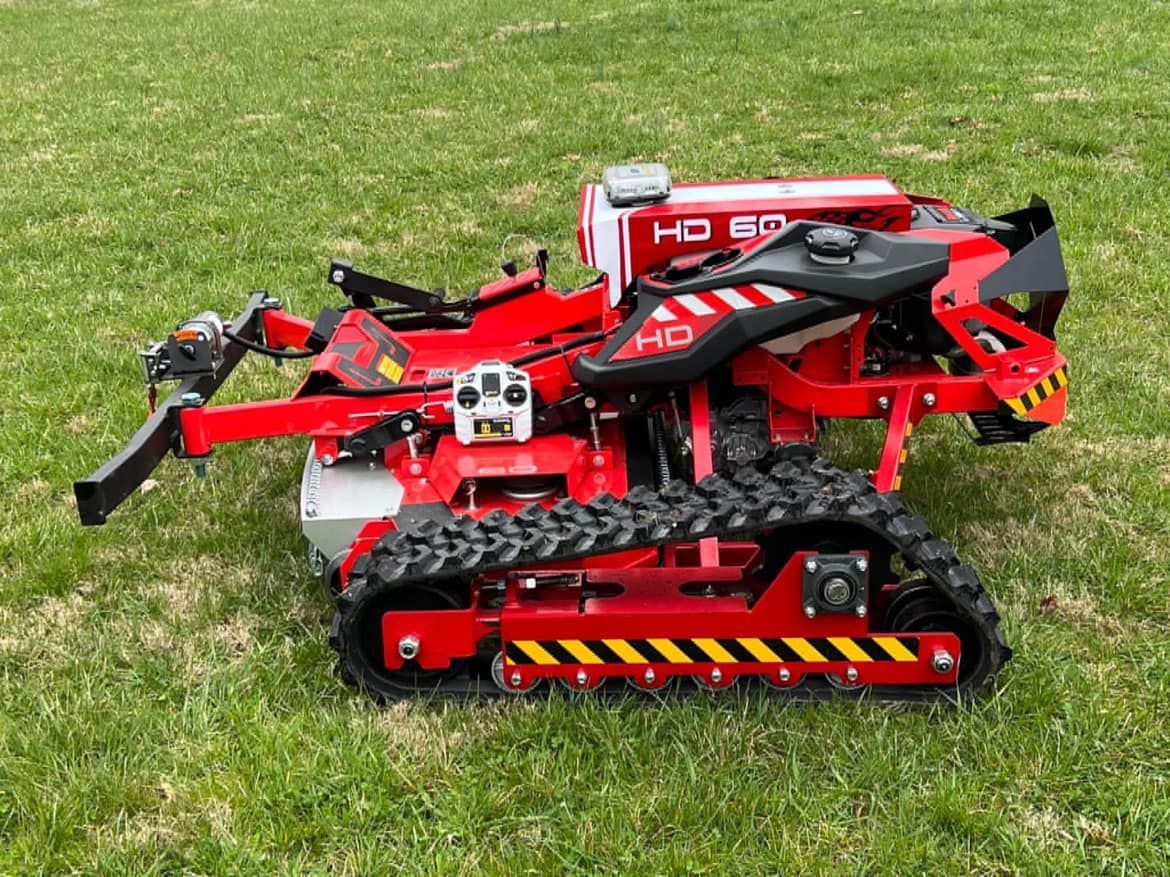
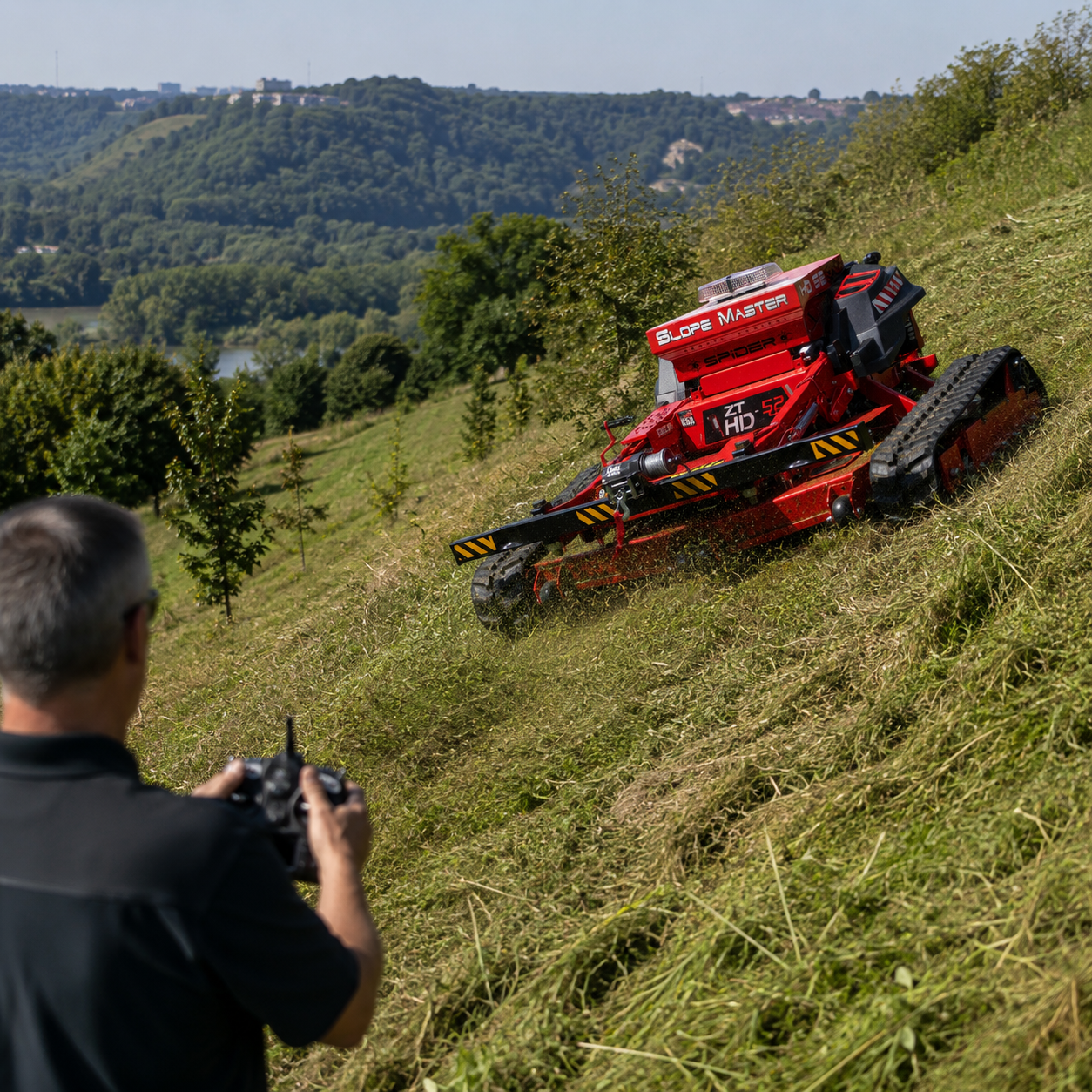
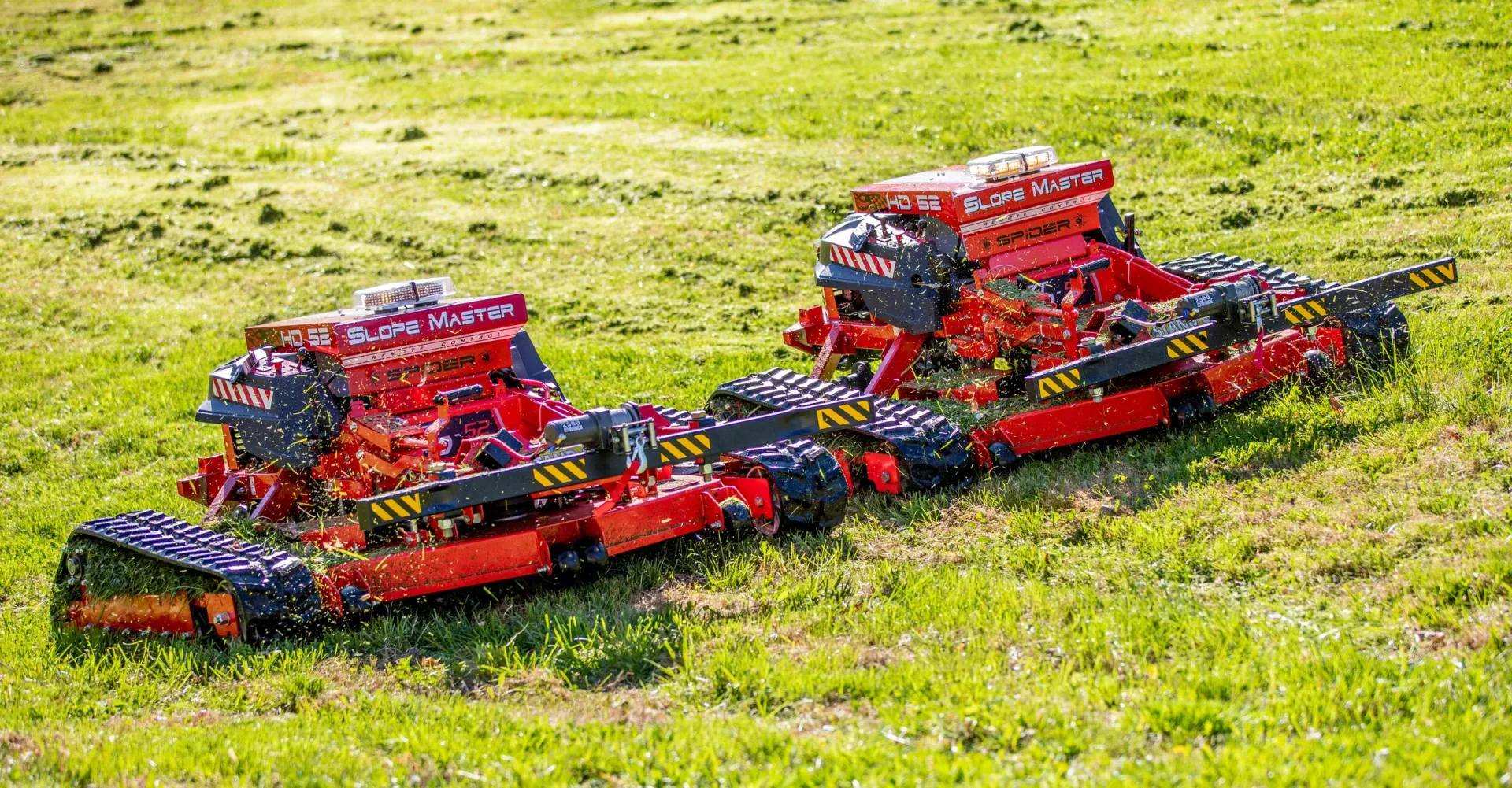
Slope Master mowers use heavy-duty tank-style track systems designed for steep hillsides, roadside embankments, retention ponds, rough mountain terrain, and other demanding commercial environments.
Operators must still inspect each jobsite and account for moisture, vegetation, soil stability, hidden obstacles, and changing ground conditions. Tracks improve capability, but they do not make every slope safe under every condition.
3. Center of Gravity and Weight Distribution
A steep-slope mower should be designed around stability—not simply equipped with tracks after the rest of the machine has been built.
The location of the engine, deck, fuel, control components, frame, and other equipment affects how the mower’s weight is distributed. A low center of gravity and balanced design can help the machine remain more stable as the slope angle and terrain change.
Machine weight also needs context. A heavier mower may offer greater stability, traction, and structural durability, but the weight must be properly distributed. Buyers should not assume that heavier always means better or that a lightweight machine will automatically be easier to operate.
Compare:
- Total machine weight
- Width and overall footprint
- Location of major components
- Ground clearance
- Weight distribution across the tracks
- Behavior when traveling across a slope
- Stability when turning or changing direction
- Transport and trailer requirements
Slope Master’s current models range from approximately 1,360 to 1,420 pounds. Their tracked footprints, reinforced chassis, and low-profile construction are designed to provide commercial stability while maintaining useful maneuverability.
4. Commercial Engine Availability
The engine is one of the most important long-term considerations in any commercial mower.
An unfamiliar engine may appear powerful on a specification sheet, but buyers should also consider the availability of filters, belts, service information, replacement parts, and qualified repair technicians.
Questions to ask include:
- Is the engine designed for commercial use?
- Is the manufacturer established and supported?
- Are routine maintenance parts widely available?
- Can local repair facilities service it?
- Is sufficient power available for the deck and terrain?
- Will parts still be obtainable several years from now?
Slope Master Innovations uses commercial Kawasaki engines throughout its model lineup. Depending on the model, current configurations include the Kawasaki FR691V, FR730, and FX1000.
Using recognizable commercial engines makes routine service and parts sourcing more practical than relying on an unfamiliar power system with limited support in the United States.
A mower is only productive when it is operating. Engine availability, service access, and downtime should be considered alongside horsepower and purchase price.
5. Cutting Capacity and Productivity
Cutting width receives significant attention, but the widest deck is not automatically the best choice for every operation.
A wider mower can cover more ground, while a more compact machine may be easier to transport and maneuver around tight areas, obstacles, drainage structures, gates, or narrow access points.
Commercial buyers should compare:
- Finish-cut or brush-cut capability
- Cutting width
- Adjustable cutting height
- Blade configuration
- Vegetation type
- Travel speed
- Maneuverability
- Expected acres or square footage
- Access limitations
- Trailer dimensions and payload
Slope Master offers multiple cutting configurations:
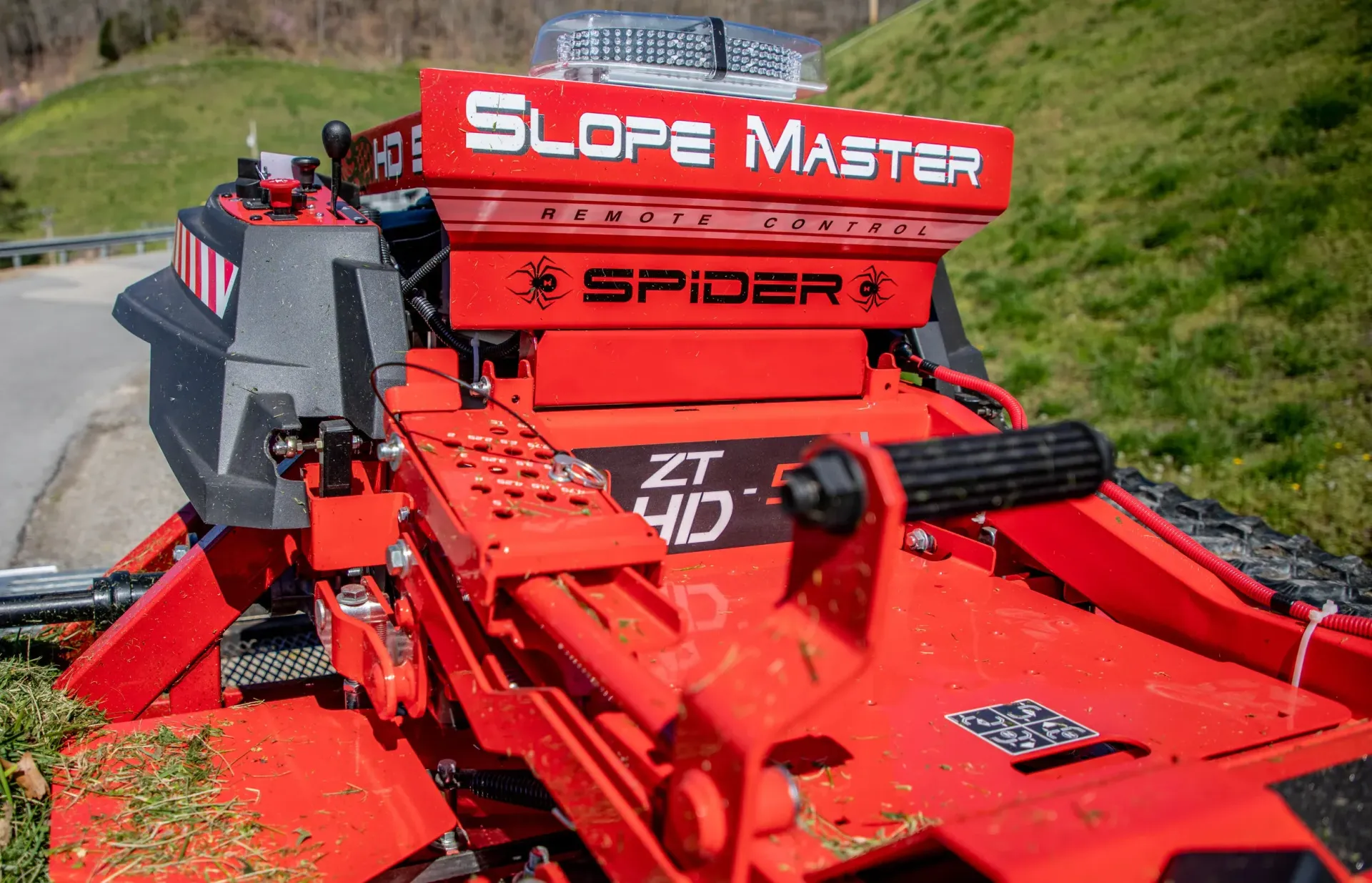
- The SPiDER: 52-inch finish cut with a 1.5- to 5-inch adjustable cutting height
- The Industrial Dual Cut: 60-inch finish cut with two cutting sections
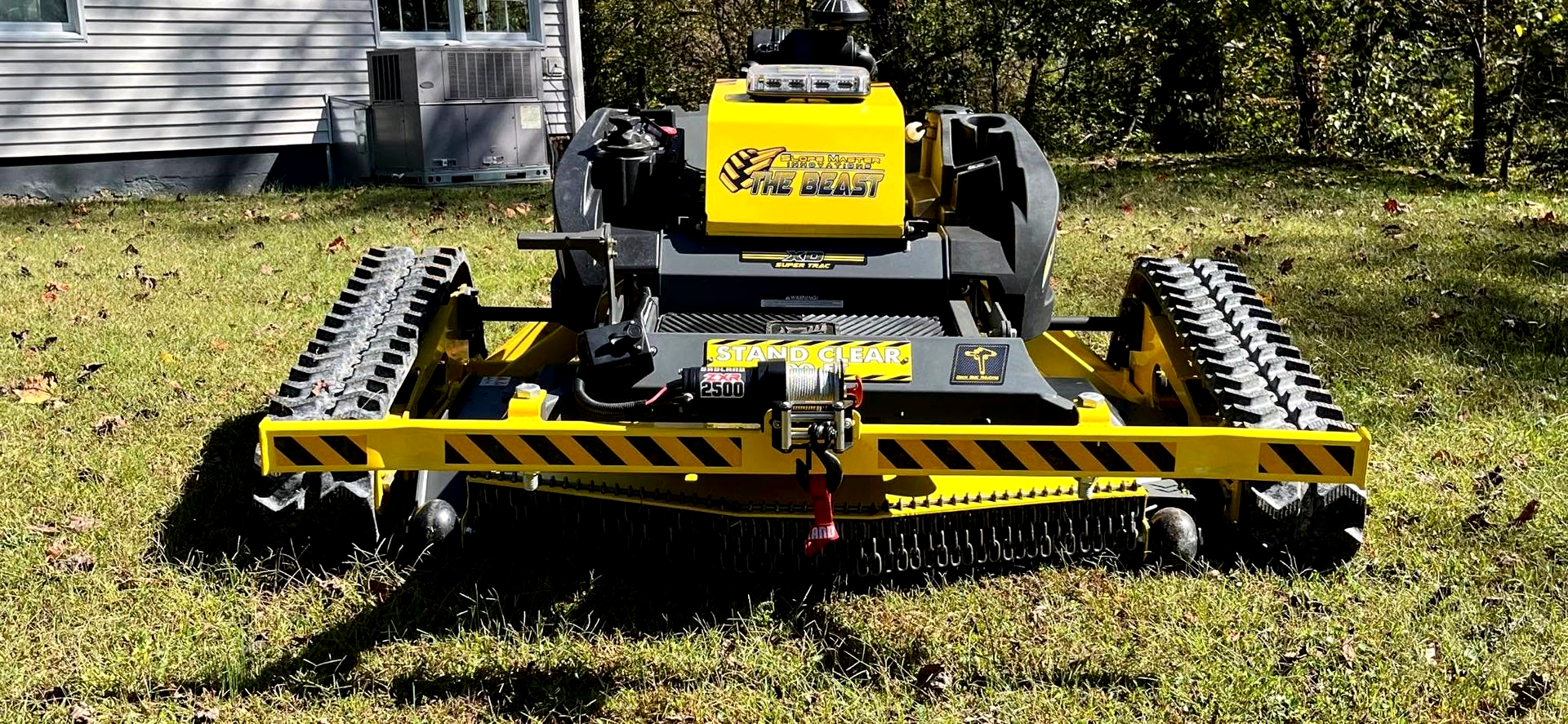
- The Beast: 61-inch finish cut for large-scale commercial and industrial work
Each model is designed for a different balance of maneuverability, cutting coverage, terrain, and production requirements.
The right cutting capacity is the one that matches the work being performed—not simply the largest deck available.
6. Safety Controls and Emergency Shutoffs
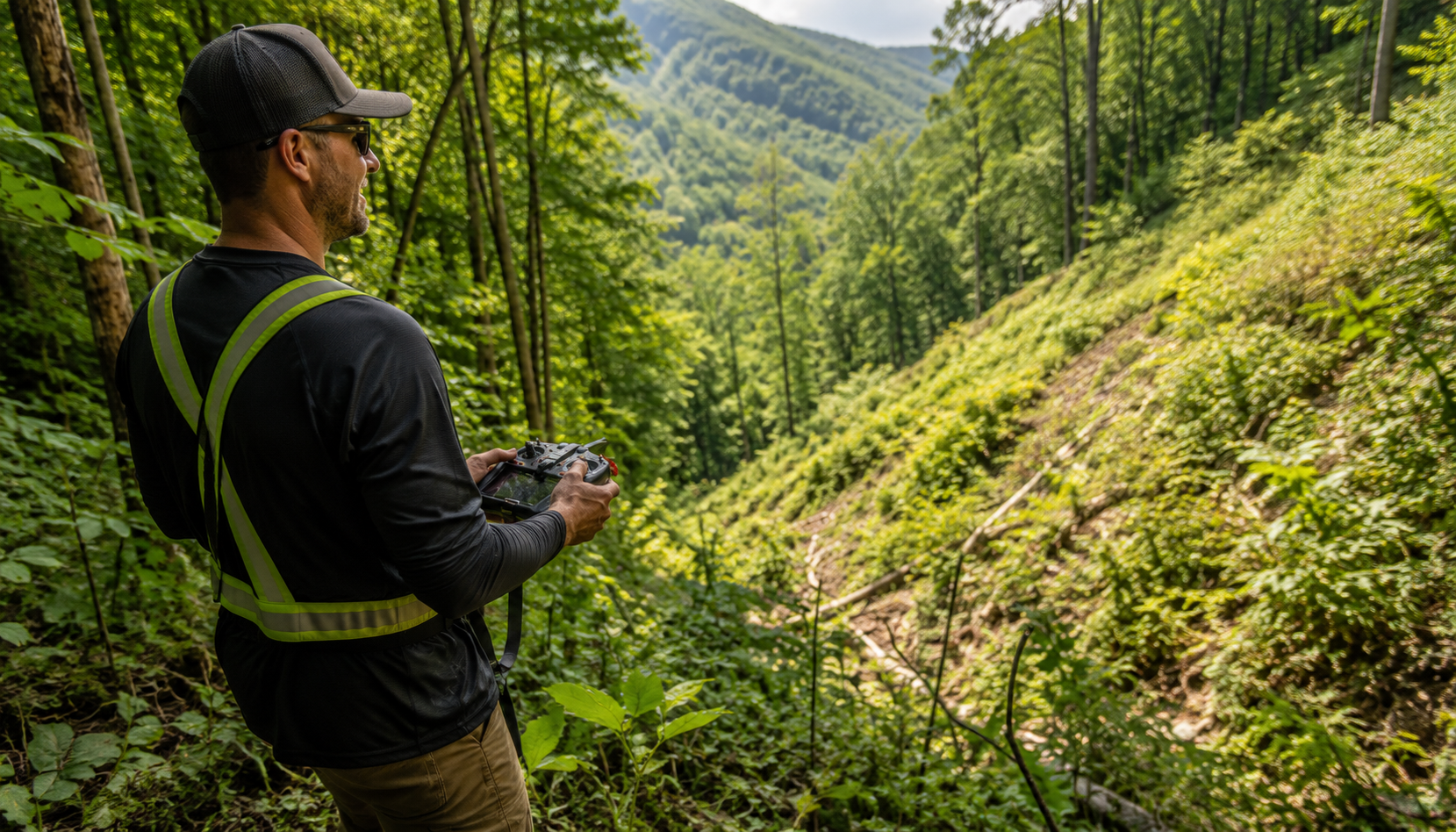
Remote operation helps keep the operator off the mower and away from the most hazardous portion of the slope. However, commercial-grade equipment should also include systems that allow the operator to respond quickly when conditions change.
Buyers should ask about:
- Emergency shutoff controls
- Redundant stopping systems
- Remote-control range
- Signal-loss behavior
- Warning or alert lights
- Control responsiveness
- Operator visibility
- Training procedures
- Inspection requirements
- Manufacturer operating guidelines
Slope Master equipment includes multiple emergency shutoffs, alert lights, remote operation, and other safety-focused features designed for commercial slope mowing.
These systems help reduce operator exposure, but they do not replace training or judgment. The operator remains responsible for inspecting the terrain, choosing a safe working position, monitoring the equipment, and stopping the machine when conditions become unsuitable.
Be cautious of any equipment provider that describes a machine as completely risk-free. Commercial mowing always requires responsible operation, especially on steep, wet, loose, or obstructed terrain.
7. Recovery Equipment and Jobsite Access
Even capable equipment can encounter difficult areas.
Loose soil, mud, hidden holes, stumps, logs, steep transitions, narrow access points, and drainage channels can create situations where a machine needs assistance or repositioning. A commercial mower should have a practical recovery strategy before it enters the job site.
Compare:
- Factory-installed winches
- Winch capacity and placement
- Recovery attachment points
- Optional secondary recovery equipment
- Access to the winch controls
- Manufacturer recovery instructions
- Compatibility with the intended terrain
Slope Master models include a recovery winch to assist with obstacles, tight areas, rough terrain, and repositioning. A second winch can also be installed when the customer’s application calls for additional recovery capability.
Recovery equipment should not be treated as a substitute for safe operating practices. Its value is in giving commercial operators another tool for managing difficult job sites and unexpected terrain.
8. Replacement Parts and Serviceability
Parts availability may not feel urgent while comparing new machines, but it can become one of the most important ownership considerations later.
A lower-cost imported mower may appear attractive until a proprietary component fails and the replacement must be sourced from an overseas supplier. Long shipping times, uncertain compatibility, limited documentation, and unavailable service assistance can turn a minor repair into extended downtime.
Before purchasing, ask:
- Which parts are proprietary?
- Which parts are standard and readily available?
- Can local suppliers provide routine service components?
- Is technical documentation available?
- Can the owner perform basic maintenance?
- Does the manufacturer offer repairs?
- Can the machine be rebuilt?
- Is phone-based technical support available?
Slope Master designs its machines using widely available components wherever practical. Many standard parts can be sourced through common automotive and equipment retailers, helping customers maintain and repair their machines without depending entirely on a distant or unfamiliar supply chain.
Slope Master also provides repairs, maintenance, upgrades, and total rebuild services. That serviceability helps protect the equipment as a long-term operational asset.
9. Customization and Future Upgrades
Commercial mowing operations are rarely identical. A landscaping contractor may prioritize transportability and maneuverability. A municipality may need greater cutting coverage and safety equipment. An industrial facility may have unique access requirements. A large landowner may need a machine configured for rough mountain terrain.
A truly commercial manufacturer should understand that the standard configuration is not always the final answer. Potential customization areas include:
- Cutting width
- Engine and power options
- Machine weight
- Trailer compatibility
- Overall dimensions
- Recovery winches
- Safety and visibility equipment
- Transport requirements
- Performance modifications
- Rebuilds and future upgrades
Slope Master Innovations builds its machines from the ground up and offers custom fabrication based on the customer’s terrain, application, transportation needs, and operational goals.
Customization can also extend the useful life of the equipment. If an operation changes, the machine may be upgraded or rebuilt instead of immediately replaced.
10. Warranty, Training, and Manufacturer Support
The relationship with the manufacturer should not end when the mower is delivered.
Commercial buyers are making a significant equipment investment. They should understand who will answer questions, provide training, help diagnose problems, supply parts, process warranty claims, and support the machine throughout its working life.
Compare:
- Length and scope of warranty coverage
- Parts and workmanship coverage
- Operator training
- Delivery or setup assistance
- Phone and technical support
- Maintenance guidance
- Repair services
- Rebuild capabilities
- Responsiveness after the sale
Slope Master Innovations provides warranty coverage for parts and workmanship along with ongoing technical support and training. The company also provides maintenance, repairs, upgrades, and rebuild services to help customers protect the long-term value of their machines.
For a commercial contractor or public agency, support is not simply a convenience. It affects uptime, productivity, crew confidence, and the total cost of owning the equipment.
Purchase Price vs. Total Cost of Ownership
Purchase price matters, but it should not be the only comparison.
A less expensive machine may cost more over time if it creates frequent downtime, requires hard-to-find parts, cannot be serviced locally, lacks useful recovery equipment, or must be replaced after limited commercial use.
Total cost of ownership can include:
- Initial purchase price
- Freight and delivery
- Training
- Routine maintenance
- Replacement parts
- Repair labor
- Downtime
- Lost job revenue
- Transportation equipment
- Insurance
- Financing costs
- Resale or rebuild value
- Expected service life
The right commercial slope mower should help the organization complete more work, protect its crews, reduce dependence on labor-intensive methods, and pursue projects that conventional equipment cannot efficiently handle.
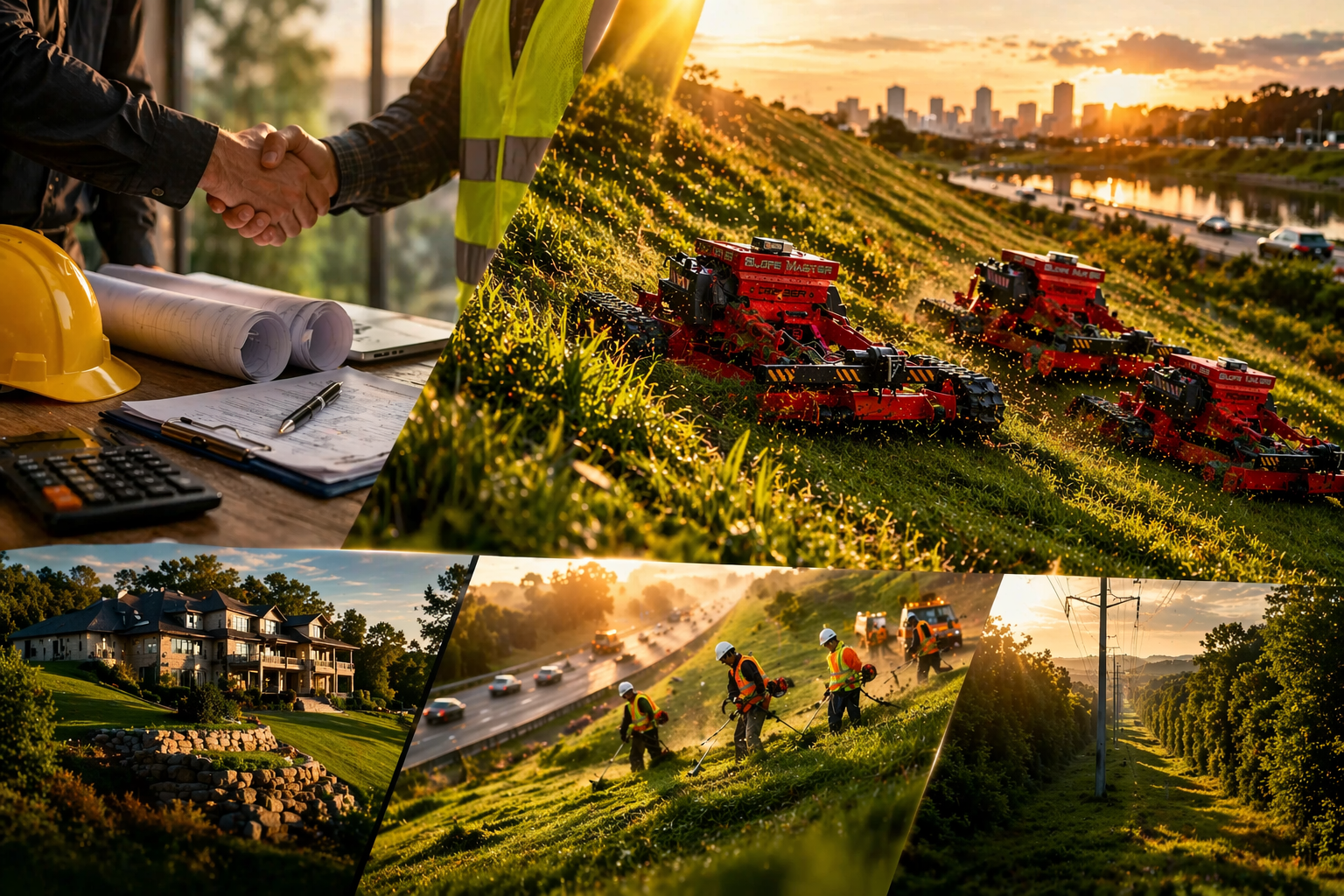
A commercial landscaper may use that capability to bid on higher-value contracts. A municipality may use it to maintain more terrain with limited crews. An industrial facility may reduce its reliance on outside slope mowing services.
Those operational benefits should be considered alongside the price printed on the quote.
Choosing the Right Slope Master Model
Slope Master Innovations currently offers three commercial remote-controlled slope mower models.
The SPiDER combines a 52-inch finish-cut deck with a relatively compact footprint. It is a strong option for commercial landscapers and operators who need a versatile machine that can access tighter areas while still handling demanding terrain.
The Industrial Dual Cut offers a 60-inch finish cut with two cutting sections. It is designed for municipalities, industrial sites, commercial properties, and larger mowing projects where increased coverage improves productivity.
The Beast is Slope Master’s largest and most powerful model. It uses a Kawasaki FX1000 engine and a 61-inch finish-cut deck for demanding commercial and industrial applications.
All three models feature remote-controlled operation, tracked construction, commercial Kawasaki engines, adjustable cutting heights, recovery winches, and USA fabrication. Available customizations can help match the machine to the customer’s terrain, trailer, cutting requirements, and intended workload.
Commercial Slope Mower Buyer’s Checklist
Before selecting a machine, request clear answers to the following questions:
- Is the mower purpose-built for commercial slope work?
- Where is the machine manufactured?
- How is the frame constructed?
- What terrain was the track system designed to handle?
- How is the machine’s weight distributed?
- What commercial engine does it use?
- Are engine and service parts readily available?
- What is the cutting width and adjustable height range?
- What emergency shutoffs are included?
- What happens if the control signal is interrupted?
- Does the machine include a recovery winch?
- Can it be customized for the intended application?
- What training is provided?
- What does the warranty cover?
- Who provides repairs and technical support?
- Can the machine be upgraded or rebuilt later?
- What are the transport dimensions and total weight?
- What operating conditions affect the maximum slope rating?
A reputable manufacturer should be willing to discuss these questions in detail. Commercial buyers should understand exactly what they are purchasing and how the equipment fits their operation.
American-Made Commercial Slope Mowers Built for Long-Term Use
Slope Master Innovations manufactures heavy-duty remote-controlled slope mowers in Kentucky for customers across the continental United States.
Our machines are built by experienced American fabricators and veterans using commercial Kawasaki engines, reinforced construction, tracked designs, safety-focused controls, recovery equipment, and readily serviceable components.
Built for municipalities, commercial landscapers, highway contractors, industrial facilities, utilities, and large property owners, Slope Master equipment is designed to provide more than impressive performance in a demonstration. It is built to become a dependable part of your operation.
Call or text (606) 226-1004 to discuss your terrain, cutting requirements, transportation needs, and commercial application.
Recent Posts